

Understanding the UAE Ministry of Education Curriculum
The UAE National Curriculum
The UAE Ministry of Education (MoE) curriculum is the national education framework mandated for all government schools in the UAE and followed by a significant number of private schools — particularly those serving Arab expatriate families, UAE nationals and communities seeking a bilingual Arabic-English education. Understanding this curriculum is important for any parent considering a private school that follows the MoE framework.
Who Studies the MoE Curriculum?
- All UAE government schools (free for UAE nationals)
- Private schools that have elected the MoE framework (often bilingual Arabic-English)
- Families from Arab countries (Egypt, Jordan, Lebanon, Syria, etc.) who prefer education in Arabic
- UAE national families at private schools who want continuity with the national system
MoE curriculum private schools in Dubai are regulated by KHDA but must comply with MoE curriculum standards, which are set federally.
Structure of the MoE Curriculum
- Kindergarten (KG1–KG2): Ages 4–6; activity-based; Arabic and English introduction
- Cycle 1 (Grades 1–4): Ages 6–10; core Arabic, English, Mathematics, Science, Social Studies, Islamic Education, Moral Education
- Cycle 2 (Grades 5–8): Ages 10–14; expanded subject range; Arabic deepens; second language (English) strengthens
- Cycle 3 (Grades 9–12): Ages 14–18; stream differentiation; examinations leading to the UAE Secondary School Certificate (Tawjihi)
The Tawjihi (Grade 12 certificate) is the UAE's national secondary qualification and is required for admission to UAE government universities. It is also accepted by some universities in Jordan, Egypt and the broader Arab world.
The MoE Curriculum's Unique Features
- Arabic language instruction: Arabic is a primary medium of instruction for Arabic, Islamic Studies, Social Studies and History — making the MoE curriculum the strongest option for Arabic language development
- Moral Education: A distinctive UAE initiative introduced in 2017, Moral Education is a standalone subject at all grade levels covering ethics, character, culture and citizenship
- Islamic Education: Compulsory for Muslim students; non-Muslims are typically offered a values-based alternative
- STEM integration: The MoE has invested heavily in STEM (Science, Technology, Engineering, Mathematics) integration and coding education across all cycles since 2019
University Pathways from the MoE Curriculum
The Tawjihi is recognised primarily within the UAE and Arab world. For families intending international university applications (UK, US, Australia), the MoE curriculum is generally not the most direct pathway. However:
- UAE universities (UAEU, Khalifa University, Sorbonne Abu Dhabi) accept the Tawjihi as the primary qualification
- Arab universities in Egypt, Jordan and Lebanon accept the Tawjihi
- Some UK and Australian universities accept the Tawjihi as a foundation qualification but may require additional qualifications or foundation programmes for competitive courses
Who Should Consider the MoE Curriculum?
The MoE curriculum is most appropriate for:
- Families intending to study at UAE government universities
- Families committed to Arabic language preservation and development as a priority
- Families planning to return to Jordan, Egypt or other Arab countries for university
- UAE national families at private schools who want continuity with the national system
For expatriate families planning international university pathways, the British, American or IB curricula generally provide more direct and flexible routes.
Conclusion
The UAE MoE curriculum provides a strong, culturally grounded Arabic-medium education with growing STEM and English language integration. It is the right choice for specific families and contexts — particularly those with strong ties to the UAE or broader Arab world and a commitment to Arabic language development. Use Search Your School to browse MoE-curriculum private schools in your emirate and compare them on fees and KHDA/ADEK ratings.
Related Articles

IGCSE vs A-Levels: A Complete Guide for Dubai Parents
What's the difference between IGCSE and A-Levels? How do they affect university applications? Everything parents of British-curriculum students need to know.
Read more →
How to Choose the Right Curriculum for Your Child in Dubai
A practical, parent-focused guide to choosing the right school curriculum in Dubai — matching your child's learning style, your family's plans and your university aspirations.
Read more →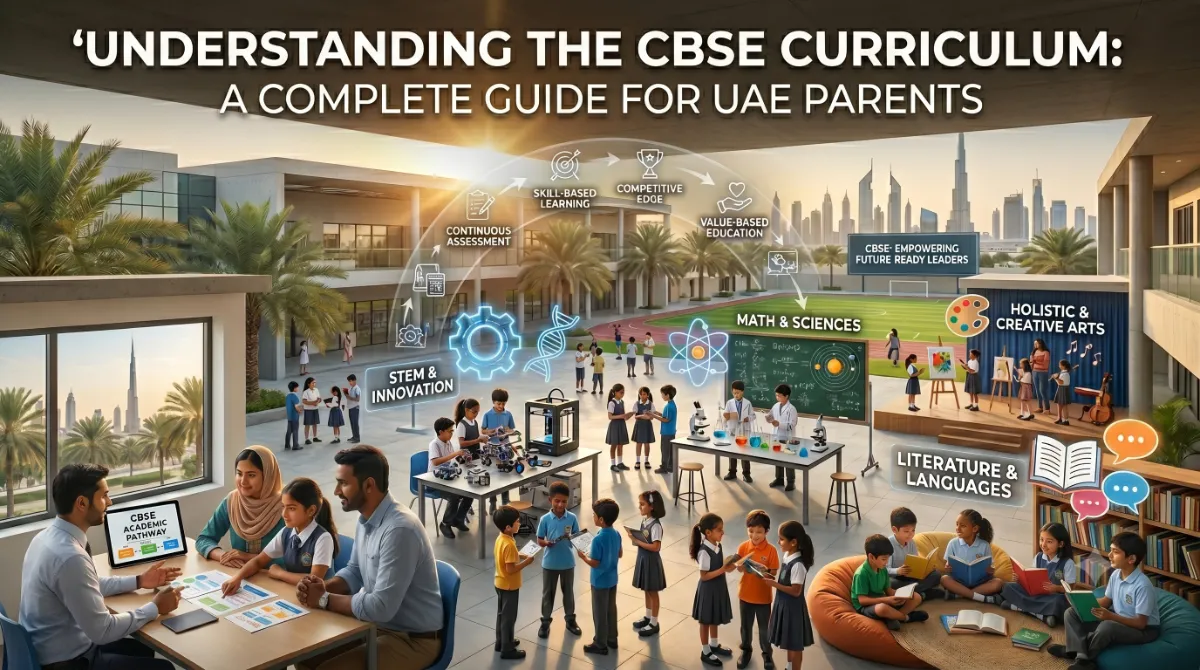
Understanding the CBSE Curriculum: A Complete Guide for UAE Parents
Everything UAE parents need to know about the CBSE curriculum — structure, subjects, board exams, and university pathways.
Read more →