
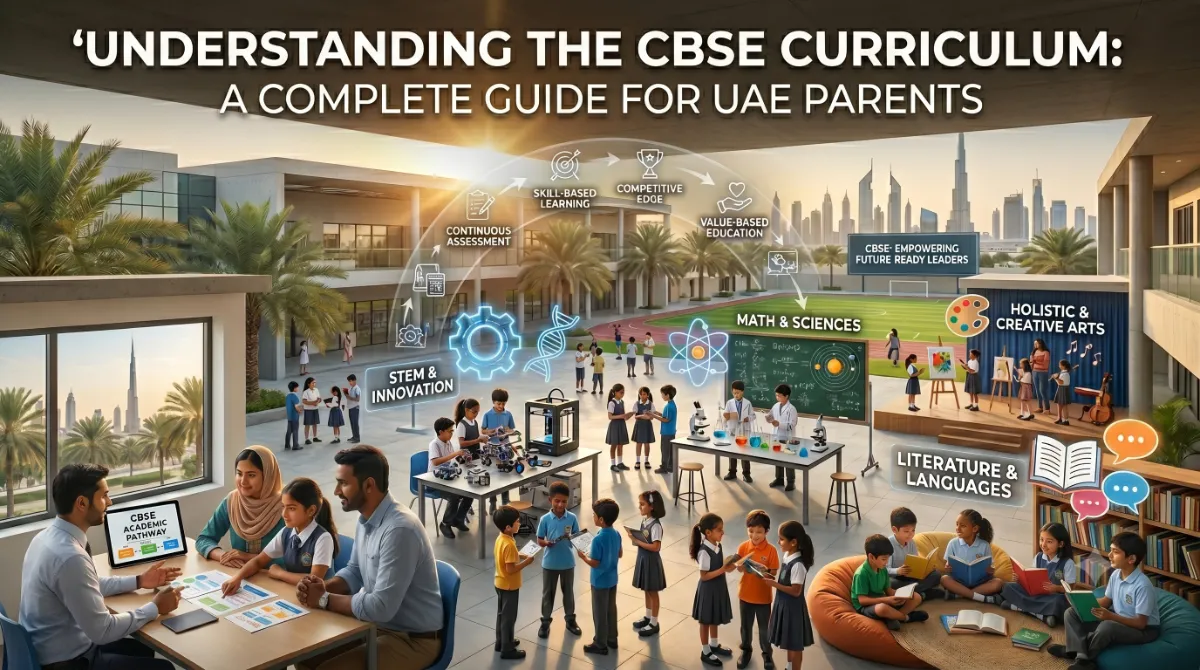
Understanding the CBSE Curriculum: A Complete Guide for UAE Parents
What is CBSE?
The Central Board of Secondary Education (CBSE) is a national-level board of education in India under the Union Government of India. It is one of the most recognised educational boards in the world, with affiliated schools in more than 25 countries. In the UAE, CBSE is the most common Indian curriculum, with over 100 CBSE-affiliated schools across the seven emirates.
CBSE Structure in the UAE
The CBSE curriculum follows a K–12 structure:
- Pre-Primary (KG1–KG2): Ages 3–5; activity-based, no formal CBSE assessment
- Primary (Classes 1–5): Ages 6–10; core subjects including English, Hindi/second language, Mathematics, Environmental Science
- Middle (Classes 6–8): Ages 11–13; expanded subject range including History, Geography, Science, Social Science, additional languages
- Secondary (Classes 9–10): Ages 14–16; culminates in the All India Secondary School Certificate (AISSE) — the Class X board exam
- Senior Secondary (Classes 11–12): Ages 16–18; stream-based (Science / Commerce / Humanities); culminates in the All India Senior School Certificate (AISSCE) — the Class XII board exam
The Class X and XII Board Examinations
The CBSE Board Examinations are high-stakes national examinations conducted in February–March each year by the Central Board. In the UAE, students sit the exams at their school or at designated examination centres.
Class X (AISSE): Students typically take 5–6 subjects. Results are graded on a 9-point Cumulative Grade Point Average (CGPA) scale. Class X performance is used for admission to Classes 11–12 stream selection and is increasingly required by UAE universities as part of admissions documentation.
Class XII (AISSCE): The Class XII result is used for admission to Indian universities (through JEE, NEET, CUET or direct admissions) and is increasingly accepted by UAE, UK and Australian universities for relevant courses. The minimum pass mark is 33% in each subject; most universities require 60% aggregate or above for competitive courses.
The Three Streams at Class XI–XII
- Science Stream: Physics, Chemistry, Biology/Mathematics (or both), English. Pathway to Medicine (NEET), Engineering (JEE), Computer Science and Science degrees globally.
- Commerce Stream: Accountancy, Business Studies, Economics, Mathematics/Informatics Practices, English. Pathway to B.Com, BBA, CA, MBA and business degrees.
- Humanities Stream: History, Political Science, Geography/Psychology/Sociology, English, electives. Pathway to BA, Law, Social Sciences, Media and Arts.
CBSE in the UAE: Special Considerations
CBSE schools in the UAE must follow CBSE Board guidelines but also comply with KHDA (in Dubai) or ADEK (in Abu Dhabi) requirements. This creates some unique characteristics:
- UAE CBSE schools are required to teach Arabic as a subject (typically two to three periods per week)
- Islamic Education is offered to Muslim students (waived for non-Muslims)
- Many UAE CBSE schools supplement the standard CBSE curriculum with additional English language enrichment to meet the needs of a multilingual student population
University Pathways from CBSE in the UAE
- Indian universities: Direct eligibility for undergraduate admission through CUET (Common University Entrance Test) or JEE/NEET for technical and medical programmes
- UAE universities: Class XII results accepted by most UAE universities; specific grade requirements apply (typically 70%+ aggregate for competitive programmes)
- UK universities: UCAS accepts CBSE results; typically requires 75–85% in three relevant Class XII subjects as equivalent to required A-Level grades
- US universities: Most accept CBSE results alongside SAT/ACT scores; transcript evaluation by WES (World Education Services) may be required
- Australian universities: Generally accepted; each university applies its own conversion for Class XII percentages to ATAR equivalents
Pros and Cons of CBSE in the UAE Context
ProsCons Very affordable feesLess breadth than IB or A-Levels Excellent for JEE/NEET preparationStream locked in at Class XI — limited flexibility Strong maths and science foundationRote-learning emphasis in some schools Continuity when moving between UAE and IndiaSwitching to British/American curriculum after Class IX is difficult Large peer community of Indian familiesUK/US universities require additional documentationConclusion
CBSE is an excellent curriculum choice for UAE families with connections to India, aspirations towards Indian higher education, or budget constraints that make British or IB schools impractical. The board's strong emphasis on science, mathematics and structured learning produces well-prepared, academically rigorous students. For families planning to remain in the UAE long-term or aspiring to UK/US universities exclusively, the British or IB curriculum may provide a more direct pathway. Use Search Your School to compare CBSE schools in your area.
Related Articles

IGCSE vs A-Levels: A Complete Guide for Dubai Parents
What's the difference between IGCSE and A-Levels? How do they affect university applications? Everything parents of British-curriculum students need to know.
Read more →
How to Choose the Right Curriculum for Your Child in Dubai
A practical, parent-focused guide to choosing the right school curriculum in Dubai — matching your child's learning style, your family's plans and your university aspirations.
Read more →
Understanding the UAE Ministry of Education Curriculum
What is the UAE MoE curriculum? Who studies it and why? A guide for parents considering the UAE national curriculum for their children.
Read more →