
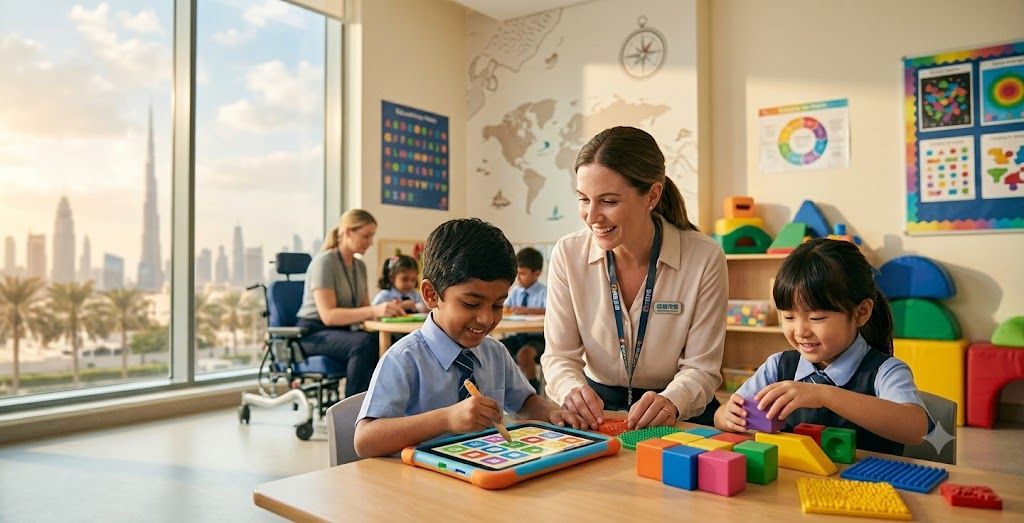
SEND Education in Dubai: Options for Children with Special Educational Needs
SEND Provision in UAE Schools: The Landscape
Families with children who have Special Educational Needs and Disabilities (SEND) face a uniquely complex challenge in the UAE. Unlike in the UK (where SEND provision is governed by a comprehensive legal framework including Education, Health and Care plans) or the US (where IDEA mandates free and appropriate public education for all children with disabilities), the UAE's SEND framework for private schools is still developing — though it has made substantial progress over the past decade.
This guide provides an honest overview of what SEND provision currently looks like in Dubai's private schools, how to navigate the system, and where the strongest options lie for children with different types of needs.
The Legal Framework: UAE Inclusion Policy
In 2006, the UAE Federal Law No. 29 established the rights of persons with disabilities, including the right to education. KHDA has implemented the Inclusion Policy for Dubai private schools, which requires schools to:
- Accept children with identified learning difficulties and mild disabilities where the school can reasonably accommodate their needs
- Provide Learning Support (LS) provisions and named Learning Support Assistants (LSAs) for students who require them
- Develop Individual Education Plans (IEPs) for students with identified SEND
- Employ qualified SENCO (Special Educational Needs Coordinator) staff
- Include students with SEND in standard KHDA inspections, with inspectors specifically assessing the quality of inclusion practice
Importantly, schools may decline admission or place a student on a "trial" basis if the child's needs exceed what the school can reasonably accommodate. This is legal under UAE regulations but must be assessed on a case-by-case basis — schools cannot categorically refuse to consider children with specific diagnoses without individual assessment.
Types of SEND Commonly Encountered in Dubai Schools
The most common types of learning support needs seen in Dubai's private school population include:
- Dyslexia and reading/writing difficulties
- Dyscalculia (mathematical difficulty)
- Dyspraxia / Developmental Coordination Disorder (DCD)
- ADHD (Attention Deficit Hyperactivity Disorder) and ADD
- Autism Spectrum Disorder (ASD) — mild to moderate
- Speech, Language and Communication Needs (SLCN)
- Anxiety and social-emotional difficulties
- Hearing impairment (mild to moderate)
- Visual impairment (mild to moderate)
Schools vary significantly in their capacity to support different types of need. A school with an excellent dyslexia support programme may have limited capacity for students with ASD. Always discuss your child's specific profile with the school's SENCO before committing to a place.
Getting a Diagnosis in Dubai
The first step in accessing SEND support is usually an assessment and diagnosis. In Dubai, assessments are typically conducted by:
- Educational psychologists: Private practice at specialist clinics (American Academy Dubai, Camali Clinic, DSOA Medical Center, Lighthouse Arabia). Cost: AED 4,000–12,000 for a comprehensive psychoeducational assessment.
- Speech and language therapists: For SLCN assessments. Available privately and through some medical insurance plans.
- Child psychiatrists / developmental paediatricians: For ADHD and ASD assessments. Dubai and Abu Dhabi have several strong specialists. Waiting times of 2–4 months are common for first appointments.
Once a formal report is available, share it with the school's SENCO. Most Dubai schools use the report as the basis for developing an IEP and allocating support resources.
Schools with Strong SEND Provision in Dubai
Dubai British School Jumeirah Park
DBS Jumeirah Park is widely recognised in the parent community as one of the most inclusive mainstream British schools in Dubai. Its SENCO team is large, well-qualified and proactive, and the school's approach to differentiated teaching is genuinely embedded rather than retrofitted. It has particularly strong provision for dyslexia, ADHD and mild ASD. KHDA: Very Good.
Kings' School, Umm Suqeim
Kings' School has a longstanding commitment to inclusion and is particularly well regarded for supporting children with social-emotional needs. It employs full-time speech and language therapists and an occupational therapist on campus — rare in Dubai's mainstream school sector. KHDA: Very Good.
GEMS Wellington International School
As one of Dubai's largest schools, Wellington has the resources to support a wide range of needs, including more complex profiles. The Learning Enhancement department is well-staffed and offers specialist support for gifted students alongside those with learning difficulties. KHDA: Outstanding.
Specialist Schools and Centres
For children with more complex or significant SEND profiles, Dubai has several specialist settings:
- Dubai Centre for Special Needs (DCSN): Government-funded, free for UAE nationals; limited places for expatriate children; strong ASD provision
- Sunflower School: Private specialist school for students with moderate to severe learning difficulties and ASD
- GEMS Metropole: Offers a specialist SEND unit alongside its mainstream British curriculum
- Rashid Centre for People of Determination: Primarily serves UAE nationals but has some privately funded places
What to Ask Schools When Your Child Has SEND
- Who is the named SENCO and what are their qualifications?
- How many students currently have active IEPs? What is the ratio of SENCO staff to SEND students?
- Are Learning Support Assistants (LSAs) allocated 1:1 or shared? For how many hours per day?
- Does the school have on-site speech and language therapy, occupational therapy or educational psychology support? Or do you need to arrange private therapy separately?
- How is the IEP developed? Are parents involved in target-setting?
- How does the school communicate progress against IEP targets?
- What happens if my child's needs change or escalate?
Medical Insurance and Therapy Costs
Private therapy in Dubai — speech and language, occupational therapy, ABA for ASD — is expensive. Costs of AED 400–800 per session are common. Dubai Health Authority (DHA)-regulated medical insurance (mandatory for all Dubai residents) may cover some therapy costs, but coverage varies enormously by plan. Always check your policy for:
- Maximum annual benefit for speech therapy / OT
- Whether a referral from a paediatrician is required
- Which clinics and therapists are on the approved panel
Summary
SEND provision in Dubai is improving rapidly but remains variable across schools. For families with children who have identified learning needs, school selection requires more research and more targeted questions than for typically developing children. The strongest mainstream options — DBS Jumeirah Park, Kings' School, Wellington — have genuine inclusion cultures and well-staffed SENCO teams. For more complex profiles, specialist settings are available but limited in number. Search Your School's SEND filter helps you identify schools that have declared strong learning support provision.
Related Articles
Supporting Children with Learning Difficulties in UAE Schools
Practical advice for parents of children with dyslexia, ADHD, dyscalculia or other learning differences navigating UAE school support systems.
Read more →
Autism Support in UAE Schools: What Families Need to Know
A guide for families of children on the autism spectrum navigating school options, support systems and specialist services in the UAE.
Read more →
Inclusive Education in Dubai: What the Law Says and What Schools Must Do
A legal and practical guide to inclusion rights in Dubai schools — what the UAE law says, what KHDA requires and what parents can demand for children with disabilities.
Read more →