
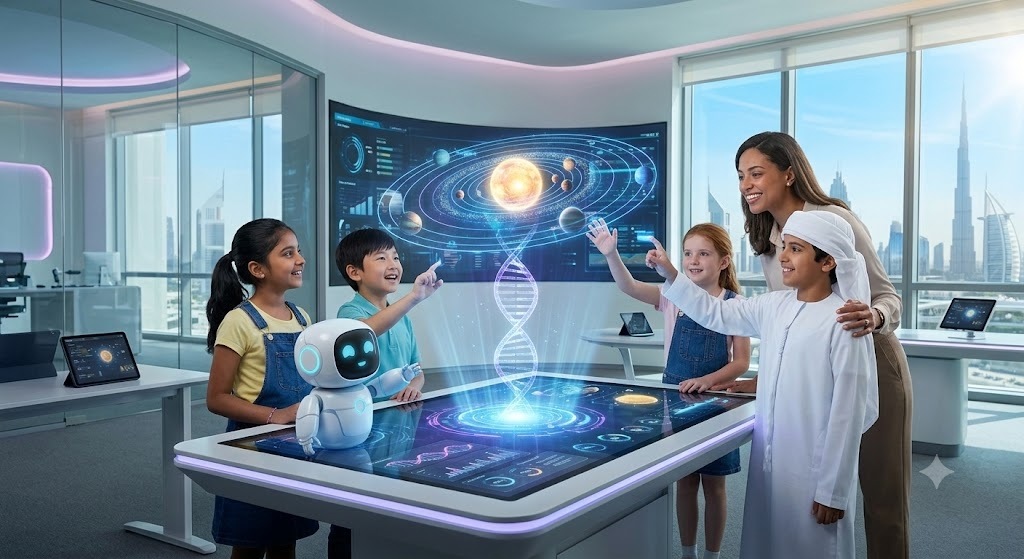
Inside the Futuristic UAE Classroom: How AI is Changing the Way Our Kids Learn
The UAE is transitioning from an oil-reliant economy into a global technology and knowledge powerhouse driven by the ambitious UAE Centennial 2071, a visionary 50-year national plan designed to transform the UAE into the world's leading nation by its hundredth anniversary. To ensure long-term, sustainable economic resilience, this overarching framework actively pivots national resources toward artificial intelligence, digital infrastructure, and advanced education, anchoring its strategy on four core pillars: establishing a future-focused government, investing in excellent education, building a diversified knowledge economy, and fostering a happy, cohesive society.
This bold economic shift is already a daily reality in UAE classrooms. By mandating AI literacy for all students from kindergarten to high school seniors, the nation has cemented its position as a global educational pioneer. Driven by the Ministry of Education's expansive Project Nova, which is a strategic national initiative that embeds advanced AI tools to automate school administration, streamline parent services, and support highly personalized student learning, schools across Dubai, Abu Dhabi, and the wider UAE have officially graduated artificial intelligence from a novelty into a core pillar of modern literacy.
The K-12 AI National Mandate: How It Works
While many nations are still debating classroom policies, the UAE has made AI literacy a core subject across all grade levels. The curriculum splits student development into specialized age groups to ensure balanced, age-appropriate exposure:
Kindergarten and Primary School: Young learners focus on screen-free, play-based digital logic. Children interact with physical, smart devices and use interactive storytelling to understand how humans train machines.
Middle School: As students transition into middle school, the focus shifts to data. They begin exploring complex datasets, learning the basics of machine learning, and finding out how to identify algorithmic bias.
High School: By upper secondary school, students are mastering advanced skills like prompt engineering and real-world machine learning simulations. They also study the ethical implications of technology to prepare directly for the digital workforce.
Beyond the Textbook: AI Avatars and the Traffic Light System in Action
The integration of AI in UAE classrooms goes far beyond basic screen time. In premium private schools, primary students use sandboxed generative AI platforms to change how they interact with literature and science, engaging in text-based chats with historical or fictional figures to boost reading comprehension. To ensure academic integrity and digital safety, educators implement a strict traffic light framework that dictates how technology is applied:
Red Light: AI tools are completely restricted, requiring students to rely entirely on their independent critical thinking.
Amber Light: Managed access is allowed for teacher-directed brainstorming and structuring raw ideas.
Green Light: Students are fully clear to use supervised AI platforms for deeper research, rapid prototyping, and running complex simulations.
In Action At : https://searchyourschool.com/ae/dubai/schools/dubai-british-school-jumeirah-park
Project Nova: Reducing Teacher Workloads Through Automation
Launched by Minister of Education Sarah Al Amiri, Project Nova is a national initiative designed to overhaul the administrative backend of the UAE school system. Rather than focusing solely on student-facing apps, this program builds an integrated institutional ecosystem that uses artificial intelligence to convert data into actionable insights for faster decision-making.
By automating routine administrative tasks like basic grading, data tracking, and scheduling, the project gives educators more time for direct classroom mentorship. At the same time, it provides parents and school leaders with real-time, proactive digital tools to track student progress seamlessly, creating a more agile and transparent education system across the country.
Personalized Learning: The End of One-Size-Fits-All Education
At the heart of this digital transformation is the shift toward deeply customized education, effectively changing the traditional classroom dynamic. Powered by regional edtech innovations like the Abu Dhabi based Alef Platform, AI systems now analyze millions of data points daily to track an individual student's real time progress, strengths, and weaknesses.
For students who grasp concepts quickly, the system automatically introduces advanced modules to keep them continuously engaged and prevent classroom boredom.
Conversely, those who need extra time receive targeted support, alternative videos, and adaptive quizzes without the pressure of feeling singled out or left behind.
By instantly matching the curriculum to a child's unique learning pace, these smart tools ensure that every student can thrive at their own speed.
Featured Schools :
https://searchyourschool.com/ae/dubai/schools/greenwood-international-school
https://searchyourschool.com/ae/sharjah/schools/the-central-school
Conclusion: The New Benchmark for Global Education
The massive push into educational technology across the country is not about replacing the human element in learning. By pairing advanced digital frameworks like Project Nova with targeted programs like the Alef Platform, the nation is building a smarter ecosystem where technology serves as a helper, not a substitute. Establishing clear boundaries early through classroom rules and a comprehensive national curriculum ensures that students learn to think critically and challenge algorithmic systems rather than depending on them. As the country moves closer to its 2071 milestones, the UAE is writing the definitive global blueprint for what a future-proof, technology-driven education system should look like.