
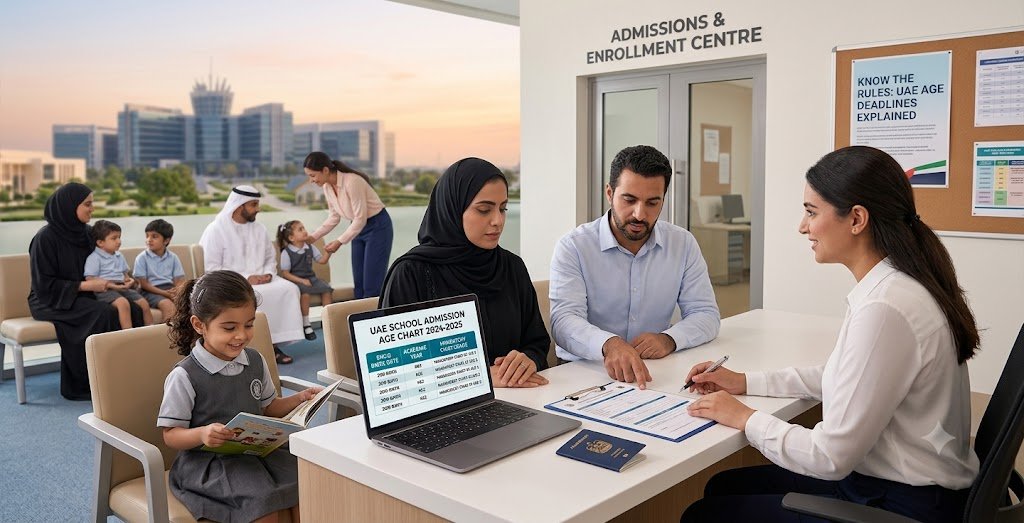
When Should Your Child Start School in the UAE? Age, Readiness and Rules Explained
The UAE School Age Question: More Complex Than It Seems
One of the most frequently asked questions by families new to the UAE — and even by some long-term residents — is: at what age should my child start school? The answer is not as simple as a single age number, because it depends on the curriculum your child's school follows, the school's specific cut-off date, and your child's individual readiness.
Entry Ages by Curriculum
British Curriculum (Foundation Stage 1)
British curriculum schools in the UAE use the EYFS (Early Years Foundation Stage) framework. Foundation Stage 1 (FS1, equivalent to Nursery or Pre-School in UK) is typically for children aged 3–4 years. Foundation Stage 2 (FS2, equivalent to Reception in UK) is for children aged 4–5 years. Year 1 (the first year of formal school) follows at age 5–6.
Most British schools in Dubai set an age cut-off for FS1 entry of 3 years old by 31 August of the academic year of entry. Some schools use 31 March as their cut-off. Always check the specific cut-off with the individual school.
American Curriculum (Kindergarten)
American curriculum schools typically begin with Kindergarten (KG) for children aged 5–6 years. The year before (Pre-K or KG1) serves children aged 4–5. The cut-off date for KG entry is usually 5 years old by 1 September of the academic year of entry.
IB Curriculum (PYP)
IB PYP schools typically align their entry ages with the curriculum they deliver alongside the PYP (usually British or American). Check with the specific school.
CBSE / Indian Curriculum
CBSE schools typically begin with KG1 (Kindergarten 1) for children aged 3.5–4.5 years, with Class 1 entry for children who are 5–6 years old by 1 June of the academic year. CBSE age requirements are among the most standardised, with schools required to follow the CBSE Board's official age guidelines.
The Age Cut-Off Problem: Is Summer-Born a Disadvantage?
In the British system, children born in July and August are the youngest in their school year group. Research from the UK (and increasingly from the UAE) consistently shows that summer-born children are statistically less likely to achieve the highest grades at GCSE and A-Level, are over-represented in special educational needs populations, and are more likely to be identified as "less able" during early primary — simply because they are developmentally younger than their September-born classmates.
In the UAE, some British schools allow parents of summer-born children to defer entry by one year — meaning a July-born child might start FS1 at age 4 rather than 3. However, this practice is not universal and must be agreed with the school in advance. Ask schools specifically about their deferred entry policy.
Signs Your Child Is Ready for School
Beyond age, developmental readiness is the most important factor. Key indicators that a child is ready for Foundation Stage 1 / Nursery include:
- Basic self-care: Can manage their own clothing (pull up trousers, put on shoes) and toilet themselves independently
- Communication: Can communicate basic needs and feelings in words; can understand simple instructions
- Separation: Has some experience of brief separation from parents without extreme distress (e.g., at a play group or nursery)
- Social interest: Shows interest in other children and some capacity to take turns and share
- Attention: Can focus on a simple task or activity for 5–10 minutes
No child needs to be reading or writing before starting FS1. The early years school is precisely where these foundational skills begin to develop. A child who is toilet-trained, can communicate their basic needs and has some experience of social settings is ready for FS1.
What If My Child Isn't Ready?
If your child is at the age cut-off but seems developmentally young, consider:
- An extra year at nursery — most Dubai nurseries offer a pre-school year for 4-year-olds that bridges towards FS1
- Part-time school entry — some schools allow children to start on a part-time basis and build up to full time over a term
- A developmental assessment — your paediatrician can provide a formal assessment of your child's developmental stage, which may support a deferral request to the school
The Academic Year Calendar Impact
UAE private schools follow an academic year that typically begins in late August or early September and ends in late June. Children starting school in September 2026 should have their age confirmed against the school's cut-off as of either 31 August 2026 or 1 September 2026 depending on the school's policy.
For families arriving mid-year (e.g., in January), most schools will assess and enrol children at the appropriate year group for their age, though waiting lists may mean a term's wait before a place becomes available.
Conclusion
There is no single right age to start school in the UAE — it depends on the curriculum, the school's specific policy and your child's individual readiness. When in doubt, prioritise readiness over age; an extra term or year in a quality nursery setting does no harm and may do considerable good. Use Search Your School to identify schools in your area that match your preferred curriculum and entry age.